
Planting & timing · Aug 30, 2026 · By Nell Harding
The Night Shift: What Your Lawn Does an Hour After Dark
Every mild, damp night, thousands of nightcrawlers surface across an ordinary lawn to feed, haul leaves underground, and rebuild the soil. Here is how to catch the shift change with a flashlight, and what the size of the crew says about your ground.
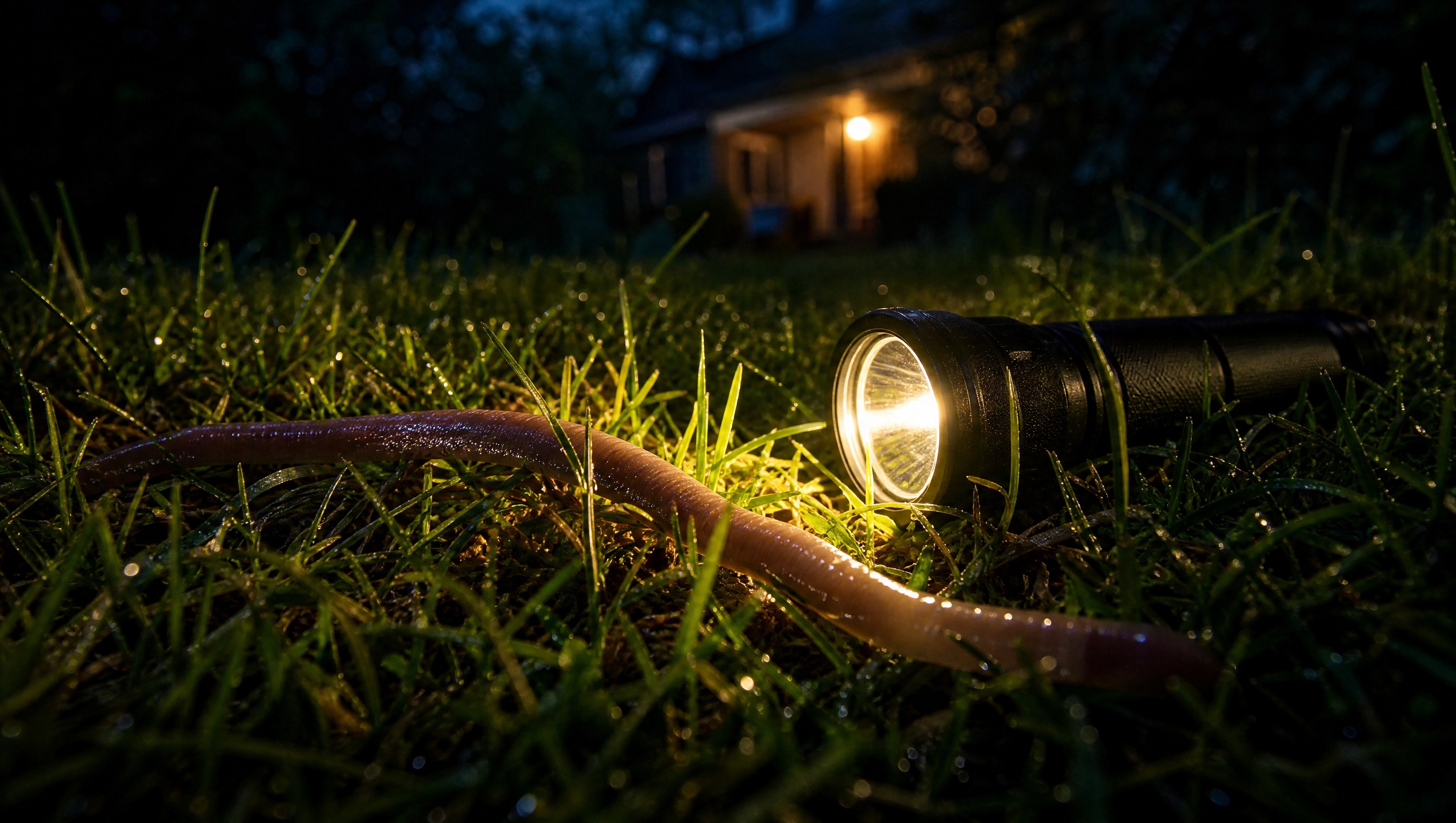

About an hour after the porch light goes off, your lawn goes to work. Nightcrawlers, some of them nearly a foot long, slide up out of their burrows by the thousand and spread across the grass to feed. It happens every mild, damp night of the season, a full shift change on the other side of the back door, and almost nobody has ever seen it.
The reason nobody sees it is the reason it is fun to try. A nightcrawler on the surface keeps its tail anchored in the mouth of its burrow, like a climber who never lets go of the rope. Its skin reads vibration through the ground. One ordinary footstep lands like a drum, and the entire lawn retracts in about half a second.
How to watch the shift change
Pick a mild night after rain, or run the sprinkler at dusk. Give the dark a good hour to settle, then go out slow. The old angler's trick is to walk on the balls of your feet and plant each step gently, because the worms forgive light far more readily than thunder.
Sweep the flashlight beam ahead of you across the grass, low and flat. What you are looking for is a wet gleam that is not a blade of grass, usually stretched away from a small hole, often with the tail still in it. Once you spot the first, you will start seeing them everywhere the beam lands. Serious worm hunters put red film over the lens, since the worms barely register red light, but an ordinary beam works if you keep it moving.
On a good night in good soil, a single sweep of an average backyard can light up dozens. They are feeding, dragging leaf fragments and grass clippings back toward the burrow, and in late summer they are also out finding each other, since nightcrawlers mate on the surface on exactly these warm damp nights.
The crew you are looking at
Charles Darwin spent his final book on these animals, and his numbers still hold up. He estimated that earthworms pass about ten tons of soil per acre through their bodies in a year, and modern counts put a healthy pasture or lawn in the range of hundreds of thousands of worms per acre. The lawn you are standing on is riddled with vertical burrows that can run six feet down.
Every one of those burrows is a drainage pipe and an air shaft. Rain that would sheet off a compacted lawn pours down worm channels instead. Roots follow the same channels, feeding on the lining of castings the worm leaves behind, which hold more available nitrogen and phosphorus than the soil they were made from.
The night shift also does your fall raking. A nightcrawler grips a leaf fragment, hauls it to the burrow mouth, and pulls it underground to soften and be eaten. Darwin watched them select leaves by shape and drag them tip-first. Over a season, a strong worm population will bury a surprising share of the leaves you never got to.
What the count tells you
A lawn that lights up with worms at night is telling you the soil underneath is alive, damp enough, and not being poisoned. Take it as a passing grade you did not have to dig for.
A quiet lawn on a perfect damp night is information too. Heavy compaction, long drought, or a bare sand base will thin the crew honestly. But the common culprit in an otherwise green suburb is chemistry. Broad-spectrum grub treatments and heavy synthetic salt fertilizers are hard on earthworms, and a lawn that gets both every year can go strangely silent underfoot.
If you want a bigger night shift, the recruiting pitch is simple. Leave clippings on the lawn, mow leaves into the grass in fall instead of bagging every one, water deeply and less often, and go easy on the harshest treatments. The worms handle the rest, and they work free.
Robins, by the way, know the whole schedule. The early bird on your lawn at dawn is not catching the worm early. It is catching the last of the night shift heading home.
