
Planting & timing · Aug 25, 2026 · By Nell Harding
The Nighthawks Leave Before Summer Does
A bird that spent all summer over your garden without an introduction is slipping south to Argentina this week, and the half hour after sunset is your last good chance to watch a season leave in person.
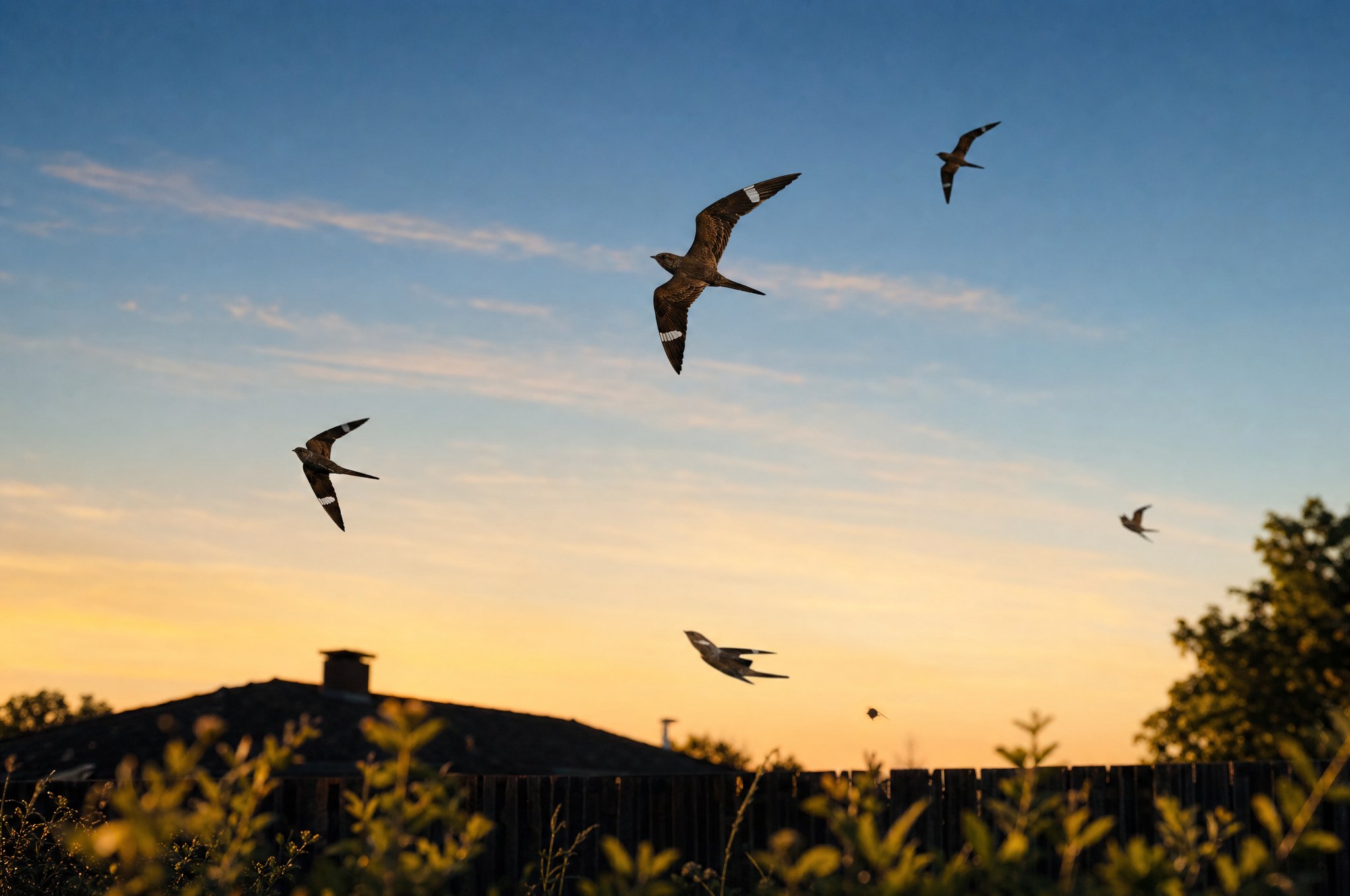

There is a bird crossing the sky over your garden at dusk this week that will spend New Year's Eve in Argentina. It was probably up there all summer, hunting the evening air while you watered, and it never once introduced itself. Now it is leaving, and the leaving is one of the quiet spectacles of late August: loose, silent flocks sliding south over rooftops and ballfields in the last usable light. If you want to watch a season end in person rather than on a calendar, this is the week to step outside after supper and look up.
The bird is the common nighthawk, and the first thing to know is that the name is wrong twice. It is not a hawk, and it does not particularly care for the night. It belongs to the nightjar family, a tribe of soft-feathered, huge-mouthed insect catchers that work the edges of the day. What looks from below like a small falcon is really a flying net: a wide, bristled mouth behind a tiny beak, built to trawl the dusk for beetles, moths and flying ants.
There is a good reason you have never met one, even after a whole summer of sharing airspace. Nighthawks spend the daylight hours lying flat and lengthwise along a branch or a fence rail, dressed in bark-colored feathers, looking exactly like a knot of wood. They cannot perch upright the way a robin does. A bird that sleeps by impersonating lumber does not show up at feeders, and so one of the most numerous birds over American towns has managed to stay a stranger.
The old folk name is honest about how they fly. Country people called them bullbats, half bull for the booming sound males make in spring dives, half bat for the stiff, twitchy, changeable way they row through the air. Once you have seen the flight you understand. Nothing else that size flies like that: sudden checks, sharp turns, a path with no straight lines in it, as if the bird were being steered by the insects it chases.
The southbound push runs from the middle of August into the middle of September, and it peaks right about now. Unlike songbirds, which slip away one by one under cover of darkness, nighthawks travel in loose companies you can actually see, sometimes dozens strung across the sky in the hour before dark, feeding as they go. A moving flock will pause to work a rich column of flying ants the way a road crew stops for lunch, then drift on south.
Where they are going explains the early start. Nighthawks winter in southern South America, as far as the pampas of Argentina, a trip of thousands of miles that ranks among the longest migrations of any bird on this continent. A traveler with that itinerary cannot wait around for the first frost. The birds leave while the leaving is good, weeks ahead of the season they are escaping, which is exactly what makes them useful to a gardener.
How to see them this week
The window is the half hour on either side of full sunset. Find open sky: the backyard works if it has a clear view, and the local ballfield or supermarket parking lot works even better, since the big lights call in insects and the insects call in nighthawks. Look high first. The birds often ride two or three rooftop heights up, and your eye will catch the flight style before it catches the bird.
Then look for the field mark that settles it. About two thirds of the way out each long, pointed wing, a nighthawk wears a bold white slash, as if someone had striped the wing with chalk. Bats flutter and never show white. Swallows are smaller, faster and gone to roost by then. A slim, dark, falcon-shaped bird with a white wristband, flying like it keeps changing its mind, is your bird.
Count what you see, and notice the direction. Ones and twos are hunters. A loose line of birds all trending the same way, generally south or southwest, is the migration itself, and every bird in it is leaving your county for the year.
The gardener's clock
We keep an eye on birds like this for the same reason the old almanacs did: the garden runs on the season's actual schedule, not the calendar's. The goldenrod opening, the walnut dropping its first leaves and the nighthawks going south all say the same thing in different voices. The long warm evenings are numbered. It is time to sow the fall greens while the soil still holds summer heat, to order garlic before the good varieties sell through, and to stop feeding the tomatoes anything but water.
It is also worth saying plainly that there are fewer nighthawks than there used to be. The birds have been in a long, slow decline for decades, along with most of the other aerial insect eaters, and the reasons come down to fewer insects and fewer nesting places. A garden cannot fix that by itself. But a yard that goes easy on the spraying and keeps a corner a little wild is, for a hungry migrant, a fuel stop on a four thousand mile road.
So take the ten minutes some evening this week. Bring your coffee or your last light chores out where the sky is open and watch for the white wristbands working south. It is a free show, it only runs for a couple of weeks, and every bird in it is carrying a piece of summer away with it.
