
Kitchen garden · Sep 11, 2026 · By Nell Harding
Why a Pear Must Be Picked Hard
A European pear is the one fruit that ripens badly on the tree. Here is why the middle goes gritty, the tilt test that tells you when to pick, and the counter or fridge plan for each variety.
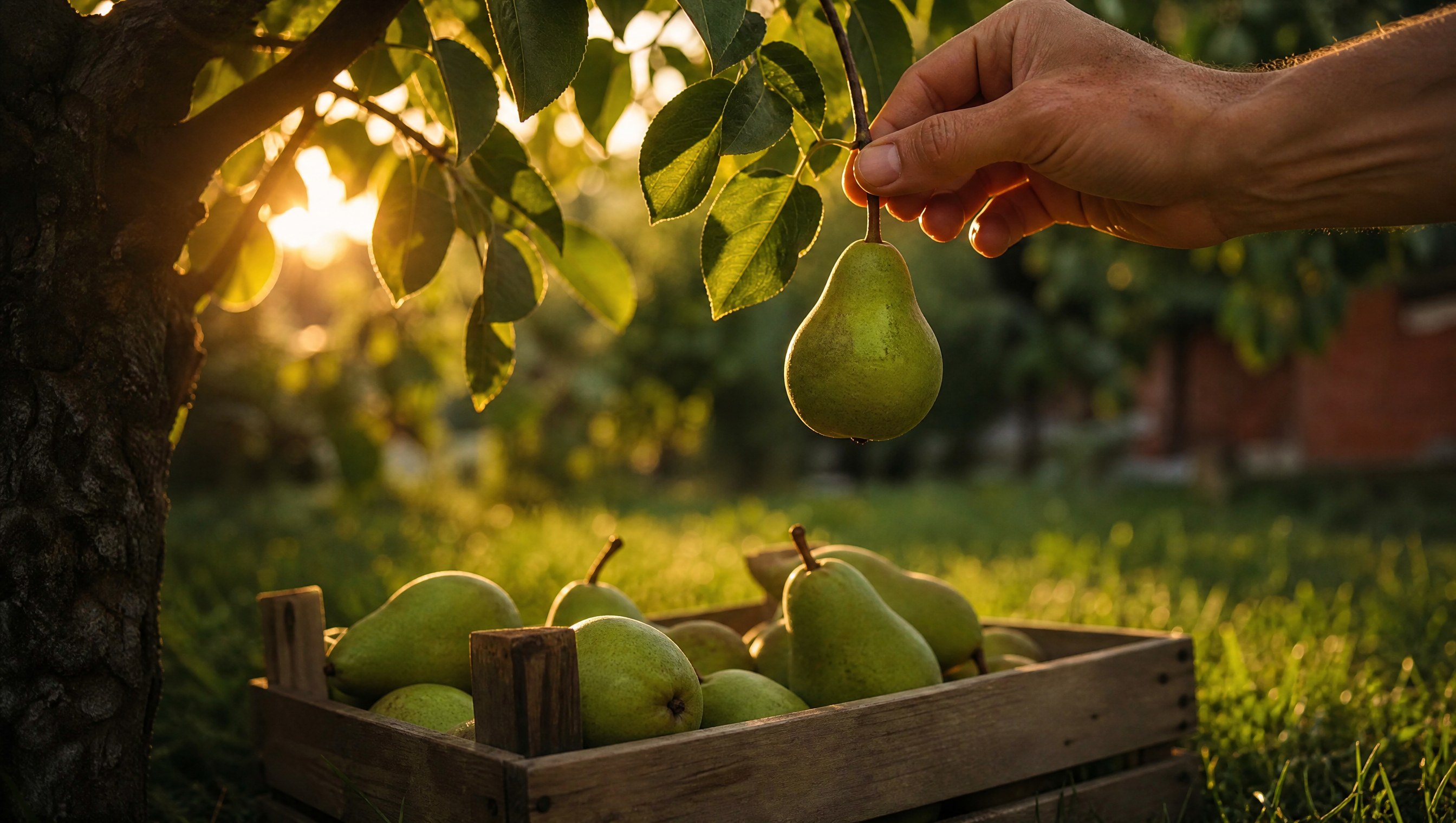

Every backyard pear tree teaches the same lesson the hard way. The fruit hangs there all of September looking almost ready, the owner waits for it to soften the way a peach does, and one morning the ground is covered in pears that are brown and mushy in the middle and gritty as sand. Nothing was wrong with the tree. The pear was doing what pears do. A European pear is meant to be picked while it is still hard, and it is one of the few fruits in the garden where waiting for ripeness is the mistake.
Why the pear is different
Most fruit ripens from the outside in, or all at once. A European pear, which means the Bartlett, the Bosc, the Anjou, the Comice and nearly every other pear sold in North America, ripens from the core outward. The flesh around the seeds softens first and the skin softens last. If the fruit is left on the tree until the outside feels ready, the centre has already gone past ripe into breakdown, brown and soft and sometimes fermenting, under a skin that still looks fine.
The grit is the other half of the problem. Pears carry small clusters of hard cells in the flesh called stone cells, and in fruit that hangs too long in warm weather those cells multiply and harden into the sandy texture everyone has met in a bad pear. Fruit picked at maturity and finished off the tree, especially with a spell of cold in between, develops far fewer of them. A buttery pear is not a different variety from a gritty one. It is the same pear, picked at the right time.
Asian pears are the exception, and worth naming so nobody applies this to the wrong tree. The round, crisp, apple-textured pears ripen on the branch like an apple and are picked ripe. Everything in this article is about the classic pear-shaped European kinds.
The tilt test
A pear does not tell you it is ready by colour or by feel. It tells you by letting go. Cup a pear in your hand and lift it sideways, tilting it up toward horizontal without pulling. A mature pear separates from the spur with a small clean snap at the stem. One that has to be twisted or tugged is not ready, and a pear forced off the tree early will shrivel on the counter instead of ripening.
There are supporting signs. The skin loses a little of its deep green and moves toward a lighter, yellower green. The small dots on the skin, the lenticels, turn from white to brown. The seeds inside a sample fruit have gone from white to dark. But the tilt is the test that matters, and on a healthy tree it comes right for most of the crop within about a week, so plan to pick the tree in two or three passes rather than one.
In most of the northern United States and southern Canada Bartlett comes ready in late August into early September, and the winter pears, Bosc, Anjou and Comice, run from mid September into October. A tree in a warm site or a warm year runs a week or two early. Fruit already falling on its own is the signal that you are late, because a windfall pear has almost always gone in the middle.
Counter or fridge, by variety
Once picked, the pears divide into two groups. Bartlett is a summer pear and needs nothing but time. Set it on the counter at ordinary room temperature, sixty to seventy degrees, and it turns from green to yellow and softens in roughly five to seven days. A paper bag with a ripe banana in it speeds that up by a day or two if you are in a hurry.
The winter pears are the ones that catch people out. Bosc, Anjou and Comice will not ripen evenly at all straight from the tree. They sit on the counter for a fortnight and either stay hard or go soft at the core while the outside is still wooden. They need a period of cold first, and this is not an old wives' tale but the way the fruit is wired. Two to four weeks in the refrigerator for Bosc and Comice, and anywhere from two to six weeks for Anjou, resets them. After the cold they come out a few at a time onto the counter and ripen in four to seven days like a Bartlett.
That cold requirement is also the storage plan for a tree that gives you fifty pears at once. Pick them hard, keep them in the coldest part of the fridge or an unheated garage that stays just above freezing, and bring out a handful every few days. Kept cold and hard, Anjou and Bosc hold for two or three months, which turns a glut into a winter of pears.
Knowing when it is ripe
The last trick is where to press. Because the pear ripens from the inside out, the belly of the fruit stays firm until it is already past its best. The place to check is the neck, the narrow part just below the stem. Press gently there with a thumb. When the neck gives slightly, the pear is ripe all the way through and the belly will still feel firm. When the belly gives, you are about a day late, and the middle is on its way to mush.
A ripe pear keeps another two or three days in the fridge if you cannot eat it that day. Do not refrigerate a pear that is still hard and needs no chilling, like a Bartlett, unless you are storing it, because cold slows the ripening you are waiting for.
So this week, go out to the tree and tilt one. If it comes away in your hand, pick the tree hard, sort them by variety, and give the winter pears their weeks in the cold. The tree has done its part. The rest of a good pear happens in the kitchen.
