
Watering & care · Sep 11, 2026 · By Nell Harding
What Is Killing Your Tomato Leaves From the Bottom Up
Nearly every tomato plant browns from the ground up by September. Here is how to tell early blight, septoria leaf spot and late blight apart in one look, which two you can ignore, and the one that means pulling the plant tonight.
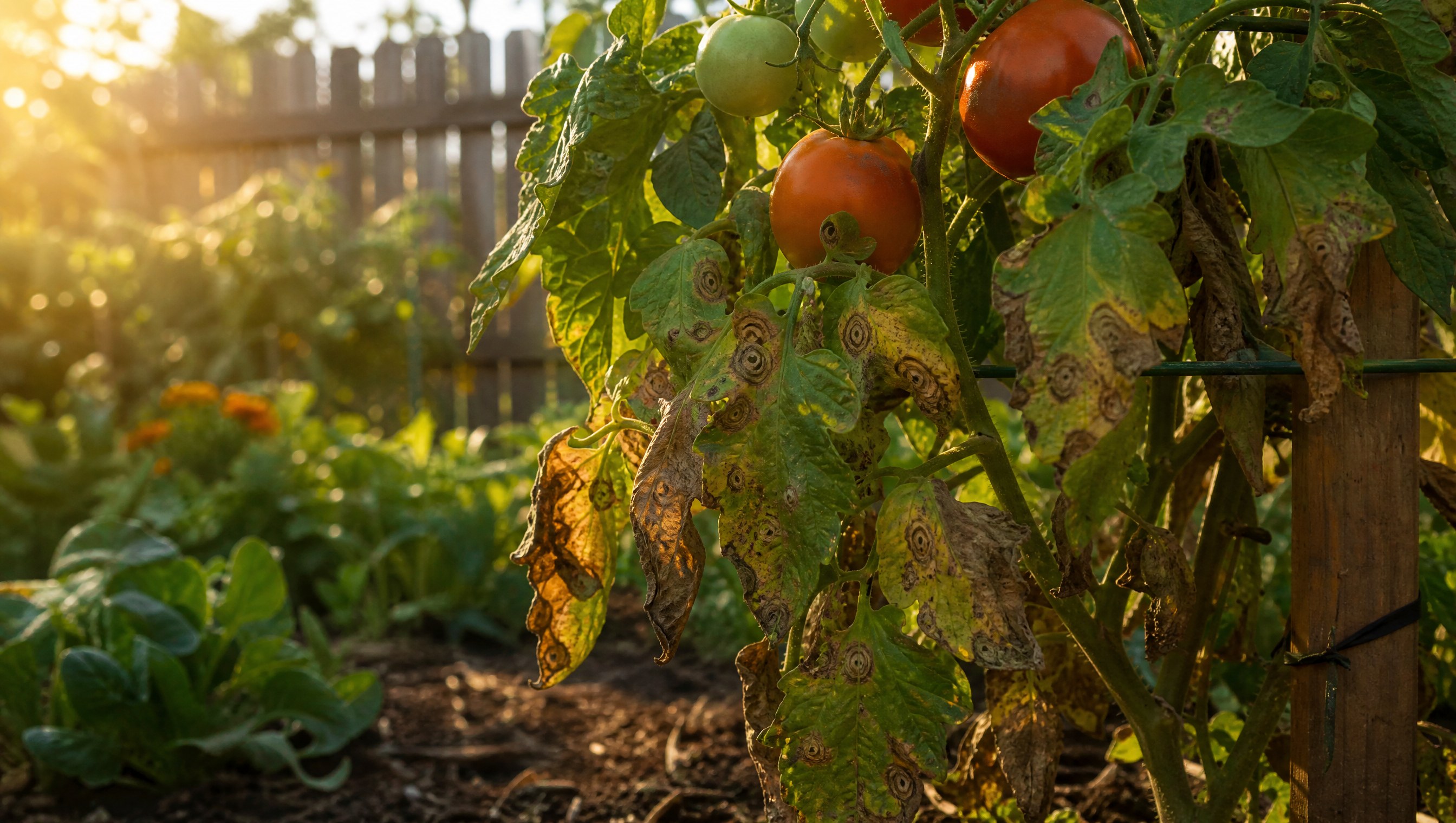

By the second week of September most tomato plants look tired. The lowest leaves have gone brown and crisp, the ones above them are spotted and yellowing, and the browning seems to climb a rung higher every week. Gardeners see this every year and most never learn which disease they are looking at, because it usually does not matter. Two of the three common causes are a normal part of a tomato's autumn and cost you nothing but leaves. The third is an emergency that spreads for miles. Telling them apart takes one look at a leaf, and it is worth learning.
First, rule out the plant simply getting old
A tomato plant retires its oldest leaves as it goes. If the lowest leaves are turning plain yellow, evenly, with no spots and no dead patches, that is the plant moving nitrogen up to the fruit and needs nothing from you. It happens faster on a plant that has set a heavy crop or one that has been a little short of water. Pinch the yellow leaves off if they bother you and move on. The three diseases below all announce themselves with spots or patches, not with clean yellowing.
Early blight: the target
Early blight is caused by a fungus called Alternaria that lives in the soil and on old tomato debris. Rain and watering splash its spores onto the lowest leaves, and from there it climbs the plant through the season. The spot it makes is unmistakable once you have seen it: a brown patch a quarter to half an inch across with darker rings inside it, one ring inside another like a target or a bullseye, often with a yellow halo around the outside. Spots merge, the leaf yellows and dies, and the disease works its way up one tier at a time. It can also make dark sunken spots on the stem end of the fruit.
The name is misleading. Early blight shows up early in warm, wet years, but in most gardens it becomes obvious in late summer, exactly when the plant has set its crop. On a September plant it costs leaves, and a plant with fewer leaves ripens fruit a little more slowly and sunburns a little more easily, but it does not take the harvest. Strip the spotted leaves as they appear, keep the plant picked, and it will finish the season looking terrible and producing fine.
Septoria: the freckles
Septoria leaf spot is the other soil-splash fungus, and it is at least as common. Where early blight makes a few large targets, septoria makes dozens of small spots on a leaf, each about an eighth of an inch across, with a dark brown rim and a pale tan or grey centre. Look closely at the grey centre and you can sometimes see tiny black dots, which are the fungus making more spores. Infected leaves yellow, then brown, then drop, and again the disease starts at the bottom and climbs.
Septoria almost never touches the fruit. It defoliates, and in a bad wet year it can strip a plant nearly bare by September, which exposes the fruit to sunscald and slows ripening. The management is identical to early blight: remove the spotted leaves, keep the lower foot of the plant clear so air moves, keep picking. In a warm autumn a well-fed plant outgrows it. In a cool wet one it wins the race, and either way the tomatoes you have already set are yours.
Late blight: the emergency
Late blight is not a cousin of the other two. It is caused by Phytophthora infestans, a water mould rather than a true fungus, and it is the organism behind the Irish potato famine. It does not creep up from the soil. Its spores arrive on the wind, sometimes from a garden or a farm miles away, and it can start on any leaf at any height. In cool wet weather it kills a plant in days.
The signature is size and texture. Instead of neat spots, late blight makes large irregular patches, grey-green and water-soaked at first as if the leaf had been scalded, turning brown, often with a pale yellow-green edge, and spreading across the whole leaf and down onto the stem, where it makes dark greasy streaks. The give-away is underneath. On a damp morning turn an affected leaf over and look at the edge of the patch for a fine white fuzz. That is the mould producing spores, and it means the plant is already infecting every tomato and potato within reach of the wind. The fruit gets firm brown greasy blotches that do not soften.
There is no home treatment once you can see it. Fungicides sold to gardeners protect leaves that are not yet infected and do nothing for the patches already there, and by the time the fuzz shows the plant is a spore factory. The responsible move is to pull the plant the same day, bag it and put it in the trash rather than the compost, and tell anyone nearby who grows tomatoes or potatoes. Potatoes are the other host, and infected tubers left in the ground are how the disease survives a northern winter.
Keep that in proportion. Late blight is a wet-year, region-by-region disease, and most gardens in most Septembers never see it. Extension services and university plant clinics track outbreaks by county, and a quick search for late blight and your state will tell you whether it is around. If it is not, the browning on your plant is almost certainly one of the two ordinary diseases above.
What actually prevents the first two
Early blight and septoria both come up from the soil, so almost everything that helps is about keeping soil off the leaves, and almost all of it is next-year work. Mulch under the plants as soon as they go in, with straw, shredded leaves or grass clippings, so rain cannot splash bare soil onto the lowest foliage. Stake or cage every plant and prune off the leaves within a foot of the ground once it is established. Water the soil, not the plant, and water in the morning so the leaves are dry by night. Space plants so air moves between them.
Rotation matters more than people expect. Both fungi overwinter on tomato debris and in the top layer of soil, so growing tomatoes in the same bed year after year hands the disease a head start each spring. Move them to a spot that has not held tomatoes, potatoes, peppers or eggplant for two or three years if you can, and clear all the dead tomato foliage out of the bed this fall rather than digging it in. Copper and other protective sprays exist and work modestly if started before the spots appear, but they protect new growth only and never cure a leaf that is already marked.
For now, in September, the job is simple. Turn a spotted leaf over. Rings or freckles, strip the leaf and keep picking. Greasy patches with white fuzz underneath, bag the plant tonight. One look sorts the whole tomato row.
